
1. Introduction
We have now reached round three and we have acclimatised to Durres.
We are also starting to walk around and get to know the place a bit as well.
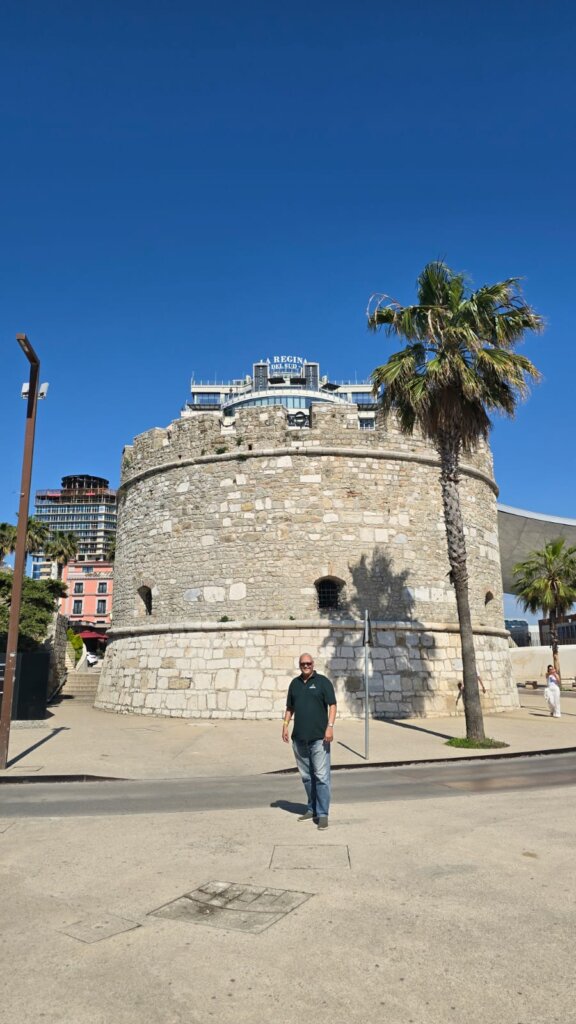
Shabier, Andre and I have started to visit some places. We went to the Venetian Tower. The Venetian Tower is a notable attraction in the city-port, forming part of the Castle of Durres., one of the most potent fortresses in the Middle-Ages along the Western Coast of the Adriatic Sea. Although it is just one element of the fortification, the tower, which was built in the 15th century, has become a significant monument in Durres. It is located near the coast along the wall that leads to the old acropolis and King Zog’s villa making it a prominent site to see.


2. The World Senior Team Championship Background
World Team events are important as it is a test of the country. The most famous Team event is of course the Olympiad. Let me recount those early days for you reader.
South Africans and Africa will celebrate 68 years of play in the Chess Olympic fold in September 2026 when it is held in Uzbekistan and 28 years of our female team participation at the Olympiad having made their debut in the Women section in Kalmykia in 1998. Tunisia was the other African country that also played in 1958.
One of the fundamental principles which appear at the beginning of the Olympic Charter states, “Olympism is a philosophy of life, exalting and combining in a balanced whole the qualities of body, will and mind. Blending sport with culture and education, Olympism seeks to create a way of life based on the joy of effort, the educational value of good example and respect for universal ethical principles” (Olympic Education Toolkit, 2007, a publication by the International Olympic Committee).
It is said that the French Chess Federation wished to organize an Olympiad alongside the Olympic Games which would be held in Paris in 1924. According to Arpad Fordeak (Chess Olympiads 1927-1968, Dover Publications, 1969, page 8) the standing of the Chess Olympic Games is a matter of dispute as most nations taking part were fewer than four players and the players from the same country competed against each other. The Federation Internationale Des Echecs (FIDE) was established at this event by the participants present.
Fordeak (page 9) states that 1927 can be seen as the official start of the Chess Olympiads. FIDE however disagrees with this and in Budapest 2024, celebrated the 100th anniversary of the founding of FIDE and the Chess Olympiads. Sixteen countries competed in 1927. The competition itself though only became known as the Chess Olympiads in 1952. Gens Una Sumus (we are one family) was the motto adopted by FIDE. Nowadays over 190 countries send their players every two years to the Olympiad to compete. Fordeak correctly records (page 10) that all World Champions and contenders for the world title have competed at the Olympiads.
South Africa joined FIDE in 1954 and entered its first Olympiad in 1958. Fordeak notes that the 1958 Munich Olympiad coincided with the 800th anniversary of the founding of Munich. Tunisia was the other African country that made its debut in 1958 in Munich.
South Africa was represented by the following players followed by their respective stats: (Springboks at Munich by Dreyer, Kirby, Heidenfeld, published by the SA Chess Player, 1959).
13th Chess Olympiad: Munich, Germany

The event was split into Preliminaries and then Finals. A quick glance at the various scores reveals some interesting wins. SA beat Finland 2.5-1.5; SA beat Portugal 3-1; SA beat Ireland 4-0; SA beat Tunisia 3.5 to 0.5 and SA beat Lebanon 2.5 -1.5.
Dreyer in the prologue (Springboks at Munich, page 3) to the abovementioned booklet asks, “Has it been worth it to send a South Africa team to the 13th Chess Olympiad in Munich? My answer is a resounding yes. We have proved to the world and ourselves that our small country with its small chess federation has produced a top class of players who do not have to be ashamed of entering the international arena, who have obtained in this outing a place far from the bottom and who moreover, have a good chance of doing better next time, whenever and wherever that may be.”
The South African government at the time was cementing apartheid throughout society. South Africa however was still competing in world events, and it is interesting to observe its interaction with the rest of the world. Buntu Siwisa writes in Rugby, Resistance and Politics, (Jacana Media, 2022), “In 1956, the Minister of the Interior, Dr Eben Donges, delivered a speech that, in many ways, officially politicised South African sport in general. It brought South African sport under the stringent apartheid policy of separate development, allocating different platforms, resources, and opportunities for each racial group. In the previous year, the non-racial movement had begun, forming the Coordinating Committee for International Recognition of Sport (CCIRS). Later it simply called itself the Committee for International Recognition (CIR).
The CIR, intent on selecting national sports teams on merit, was succeeded by the South African Sports Association (SASA) in 1958. It was founded by a group of weightlifters in East London, led by Dennis Brutus, and formally launched in Durban in 1959, with Alan Paton acting as patron.
In April 1960, police raided SASA’s offices seizing its archival material. Some were equally hounded by policemen and ensured SASA’s leadership, including Dennis Brutus were subsequently forced into exile. The association was forced to dissolve in 1963, and in its place, the South African Non-Racial Olympic Committee (SAN-ROC) was formed. This body was equally hounded by the police, and resurfaced overseas, with support from the Anti-Apartheid Movement (AAM).
The government, adamant on implementing its policies of separate development in all sporting codes, increasingly harassed non-racial sports organizations throughout the 1960’s continuing to insist that each racial group administer its sport separately. This was despite the creation of a new Department of Sport. In 1965, Prime Minister John Vorster – against the background of a debate surrounding the inclusion of Maoris in the All Blacks team of New Zealand – pointed out that, (inside) South Africa there will not be mixed sporting events, irrespective of the proficiency of the participants. On this there can be no compromise, negotiations, or abandonment of principle.”
FIDE and many countries were of course not oblivious to the political situation in South Africa. South Africa was not allowed to play in Leipzig, East Germany 1960 and in Bulgaria in 1962 as both countries were part of the Communist bloc which was in opposition to apartheid.
3. History of Albania
On the brink of being taken over by neighbouring Balkan nations in 1912, Albania was granted statehood by the Great Powers. The origin of the name “Albania” can be traced back to medieval Latin and the association with the Illyrian tribe of the Albani. This connection is further supported by the writings of the Ancient Greek geographer Ptolemy during the 2nd century AD, where he included the settlement of Albanopolis situated to the northeast of Durrës. The presence of a medieval settlement named Albanon or Arbanon hints at the possibility of historical continuity. The precise relationship between these historical references and the question of whether Albanopolis was synonymous with Albanon remain subjects of scholarly debate.
The Byzantine historian Michael Attaliates, in his 11th-century historical account, provides the earliest undisputed reference to the Albanians, when he mentions them as participants in a revolt against Constantinople in 1079. He also identifies the Arbanitai as subjects of the Duke of Dyrrachium. In the Middle Ages, Albania was denoted as Arbëri or Arbëni by its inhabitants, who identified themselves as Arbëreshë or Arbëneshë.
Albanians employ the terms Shqipëri or Shqipëria for their nation, designations that trace their historical origins to the 14th century. But only in the late 17th and early 18th centuries did these terms gradually supersede Arbëria and Arbëreshë among Albanians. These two expressions are widely interpreted to symbolise “Children of the Eagles” and “Land of the Eagles”.



4. Famous people from Albania
United under a red and black flag and with funding from neighbouring kingdoms, Skanderberg and his rebels shocked the Ottomans by resisting for 34 years. His forces lost in 1478, a decade after his death, leading to 430 years of Ottoman rule.
5. Interesting Fun facts
Weightlifting is one of the most successful individual sport for the Albanians, with the national team winning medals at the European Weightlifting Championships and the rest international competitions. Albanian weightlifters have won a total of 16 medals at the European Championships with 1 of them being gold, 7 silver and 8 bronze. In the World Weightlifting Championships, the Albanian weightlifting team has won in 1972 a gold in 2002 a silver and in 2011 a bronze medal.
We have been joined at our hotel with many weightlifters. There seems to be a competition happening here in an adjoining hotel.
6. Profile of the players
Andre Schutte- prepared by Andre.
My dad and uncle played on certain occasions. They both represent Potchefstroom University in chess.
The hype of the Fisher/Spassky world championships in Reykjavik (July/August 1972) started my interest into chess. I turned 7 just before that tournament.
They did not want to teach me and then my mother bought me my first chess book (Skaak – Cor Nortje and Martin Serfontein)
My grandmother and I worked through the book and teaches each other.
My uncle gave us a few times puzzles to solve. (Mostly end games) That triggered my liking of end games.
When I was around 9 years old, I visited the Boksburg chess club once for a rapid tournament. My first experience of a clock and my mother requested to sit next to me and press the clock. It was so stressful and time consuming that I never attended the club ever again.
During primary school (Laerskool Concordia) years it was only my grandmother and I who teaches each other. There was no chess activity at my primary school.
When I reach high school (Hoërskool Dr EG Jansen) there was a chess club. The school only had one team and our first came was against Hoërskool Alberton and I was on board one. There was no clock involved but you play two games against your opponent once with the white pieces and once with the black pieces. I had a win and a draw, and the team won 24-16 (10 players)
One of my regular opponents during high school was Gordon Meyer (not the best memories regarding results) That was also the first time that I realised that players got coaches.
I did not play any tournament except those for the Transvaal team trials. For three years in a row, I was every time around 15th and there was only one team (No age or gender differentiation)
In Standard 9 (Grade 11) I was in Hoërskool Transvalia and made the Vaal Triangle team.
The SA schools were in Pretoria, and I arrived there with no rating after that tournament I got my first rating (1700)
In Standard 10 I was back in my old school and made the Transvaal team and the SA schools’ tournament was in Port Elizabeth. (Marc Rubery gave us a few coaching lessons before we left for Port Elizabeth). There was first a Teams tournament and then an open tournament. In the second round of the open tournament I played against Donald McFarlane and his rating was 2396 and after 3 adjournments we ended up drawing. That was my biggest achievement for a long time.
During my university years (1984-1986) I met Gerhard Cruywagen and we played for Maties.
In 1988 I was in Pretoria and played at the Pretoria Chess club. That year I won the club championship, Northen Transvaal Handicap Blitz tournament and played in my first SA Open (Port Elizabeth)
I am in Bellville since 1989 and played since then for various teams. Bellville – Sanlam – Brackenfell – Bellville – Sanlam – Bellville.
I played in three World Senior Team events. (Prague – 2020, Krakow – 2024, Durres – 2026)
I am incredibly grateful for chess because I made a number of friends that will last forever.
Previous round game:
For some reason the games below the top boards are not being captured.
I now give a game played by myself and also by Andre Schutte.
Olivier,P (2096) – Bouah,L
(2071) [E73]
World Senior Team (2), 20.04.2026
1.d4 Nf6 2.c4 g6 3.Nc3 Bg7 4.e4 d6 5.Be2 0–0
6.h4 e5 7.d5 Na6 8.g4 Nc5 9.f3 h5 10.b4 Na6 11.a3 Nh7 12.Be3 f5 13.g5 f4 14.Bf2
Re8 15.Bf1 Bf8 16.Bh3 Be7 17.Bxc8 Qxc8 18.Nh3 Rd8 19.Rc1 Nf8 20.Kf1 Qd7 21.Kg2
c6 22.Qb3 c5 23.bxc5 Nxc5 24.Bxc5 dxc5 25.Qb5 Bd6 26.Qxd7 Rxd7 27.Rb1 Kf7
28.Rb3 Ke7 29.Rhb1 b6 30.Nf2 Rb7 31.a4 Nd7 32.a5 Rbb8 33.a6 Rd8 34.Nb5 Nb8
35.Ra3 Nd7 36.Nd1 Nf8 37.Ndc3 Nh7 38.Nxd6 Rxd6 39.Nb5 The rook decides to stand on d6 because the protected d-pawn must not be
released under any circumstances
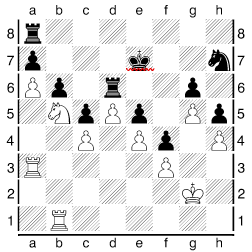
Kd7 40.Rab3 Nf8 41.Kf2 Ke7 42.Ke2 Nd7 43.Kd2 Nf8 44.Kc2 Nd7 45.Kc3 Nf8 46.Re1 Nd7 47.Kc2 Nf8 48.Nc3 Nh7 49.Ra3 Nf8 50.Ne2 Nh7 51.Nc1 Rdd8 52.Ne2 Rd6 53.Nc3 Rc8 54.Nb5 Ra8 55.Nc3 Rc8 56.Nb5 Ra8 ½–½ Not the most exciting game.
Schutte, Andre – Keller, Christopher (1993) [A10], World Senior Team (2), 20.04.2026
1.c4 b6 2.Nc3 e6 3.Nf3 Bb7 4.e3 f5 5.b3 Nf6 6.Be2 Be7 7.Bb2 0–0 8.0–0 Ne4 9.d3 Ba3
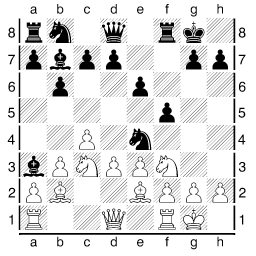
An interesting move that must be analysed. 10.Qc2 Bxb2 11.Qxb2 Ng5 12.Nxg5 Qxg5 13.e4 f4 14.f3 Nc6 15.Bd1 Qe5 16.Qd2 a6 17.Bc2 Nd4 18.Ne2 d5 19.Nxd4 Qxd4+ 20.Qf2 Qxf2+ 21.Kxf2 dxe4 22.dxe4 Rfd8 23.Rad1 e5 24.b4 c5 25.bxc5 bxc5 26.Ke2 a5 27.Ba4 Kf8 28.Rb1 Ba6 29.Bb5 Bb7 30.Rfd1 Ke7 31.Rxd8 Rxd8 32.Rd1 Rxd1 33.Kxd1 g5 34.h3 h5 35.Ke2 g4 36.hxg4 hxg4 37.Kf2 Kf6 38.a4 Ke7 39.Ke2 Bc8 40.Kf2 Kf6 41.Ke2 Kg5 42.Kf2 Kh4 43.Be8 Be6 44.Bb5 Bf7 45.Ba6 gxf3 46.gxf3 Kh3 47.Bb5 Kh2 48.Ba6 Be6 49.Bb5 Bc8 50.Bc6 Be6 51.Bb5 ½–½
7. Results of Round three

The Heavyweight Clash (Board 1)
CM Lyndon Bouah put in a captain’s performance by holding IM Michael Barron to a draw. The game was highly technical; Lyndon managed to win the exchange, but the International Master found enough positional compensation to keep the game balanced. Holding an IM on the top board is always a psychological win for the team and sets a professional tone for the rest of the match.
The Brilliance (Board 2)
The standout performance of the day belongs to FM Shabir Hussain Bhawoodien. In a classic Ruy Lopez, he demonstrated immense tactical vision by sacrificing an exchange. This wasn’t just a speculative move; it led to a brilliant mating sequence that temporarily put South Africa in a very strong position.
The Great Escape (Board 4)
While Board 3 was a setback for Anton Goosen, the match ultimately rested on the shoulders of André Schutte. Facing a higher-rated opponent in Merlin Nazareno, André found himself in deep trouble. André escaped from Alcatraz in a losing position which showed his incredible resilience. By digging in and securing the draw, he prevented a match loss and ensured the points were shared.
Final Thoughts
This match was a rollercoaster of “give and take.” While we saw flashes of brilliance on the top boards, it was the grit on Board 4 that salvaged the day. Drawing against a Toronto side featuring an IM and several titled players shows that the South African contingent remains a formidable force in international team play.
A draw feels fair – rewarding Shabir’s attacking flair while acknowledging the survival skills required at the tail end.