
1. Introduction
Chessa appointed me as manager of this trip, and I am glad to report that all managerial roles have been going well. I attended the captains meeting and settled all the finances and other aspects that needed settling. Everyone is settled and is doing their best. We are now in a routine of preparation and analysis.
Today I also spoke at the Conference called South African Sport and the Nation hosted by the Jaap Durand Chair and the UWC Faculty of Community Health Sciences. My presentation focussed on the Trilaterals and the importance of Governance in Sport Federations. It was a video presentation. Technology is amazing. Two of my colleagues also attended.
One of my readers reminded me that I normally do a player of the day. In round one we all lost, but Anton Goosen was probably the one that was closest to a win. so he gets round one player of the day. In round two Goosen again played well and won against France which secured us the draw. in round three Shabier Bhawoodien won his game and i am nominating him for player of the day!
The role of a manager
I have been given the privilege by Chess South Africa to be the manager of this team. It was not easy, as we needed to raise the funds to attend. The cost of the flight, accommodation and visas and registration worked out to be about R33 000,00 per person. Each of us as players needed to pay our own accommodation and registration fees. I needed to transfer some of the deposits to Albania and that was an issue on its own, as you need to deal with foreign exchange. I ended up having to explain to the Standard Bank Foreign Exchange department why I was transferring funds to Albania. I have been managing national teams since 2002.
Lessons learnt from managing teams
- The players need the information timeously to plan. Different players have diverse, needs but what is important is whether the event is a Round Robin, Swiss or a different format and what the implications are.
- Keep parents and sponsors always involved. Nowadays, most travels are conducted via air, and it is important that everyone has the information beforehand that is required. These are uncertain times in the Middle East. Andre was monitoring flights with me in case we needed to make changes.
- Send regular updates via email and direct via fora such as whatsapp. This will allow players, parents, and organisations to access the information timeously, but also at a later stage.
- There are various templates that must be filled out well beforehand. Most organisations have developed the templates over the years. There are templates relating to health, medical, insurance and other pertinent information that the organisers and the manager may need. This must be filled out as soon as you are appointed as a manager.
- Sticking to routines are important but the individual needs of players must come first. Some players prefer to eat early, and some prefer to sleep later. The important thing is to allow individuality and still maintain the core times such as bus schedules and playing times.
- Agree with the parents and players (depending on the context) on the times for going out and returning and the consequences for breaking the rules.
- Some players may have a magnificent event and others may struggle. Have an appreciation for this and speak quietly and privately to players that may be having a challenging time.
- Keep the public back home informed of progress via regular reports that can be sent via email to websites and directly to parents, clubs, federations, and social media.
- Aspects such as board orders and other important aspects must be dealt with early on so that any bad feelings can be dealt with while at home.
- Managing a team is a privilege and an honour. The manager is there to serve the team.
2. South Africa at the Olympiads and my perspective
The next Chess Olympiad South Africa competed in was Tel Aviv 1964. Of particular interest here to historians is the fact that South Africa played against the Soviet Union in a match which SA lost 4-0. An interesting article which recently surfaced in the New in Chess (2017) records that the Soviet team debated whether they should play against South Africa or not. After a stand-off world champion grandmaster Mikhail Botvinnik simply walked to the board and sat down. The other members of the Soviet team then walked to their respective boards as well. The full Soviet team was Mikhail Botvinnik, Tigran Petrosian, Vassily Smyslov, Paul Keres, Leonid Stein, and Boris Spassky.
This incident reflected the politics of the day. The Cold War was at its height, and the Soviet Union had links with most of the liberation movements in Africa. It later also provided military training to Umkhonto we Sizwe soldiers, the military wing of the African National Congress (ANC). The Communist countries opposed the apartheid policies, and this incident was a forerunner to what was to come in 1974.
South Africa was represented by the following players with their respective statistics (Chess Olympiads 1927-1968, Dover Publications, 1969, Foldeak page 344):
16th Chess Olympiad: 1964 Tel Aviv, Israel

In the preliminaries of the event South Africa scored the following results (out of 4).

In the Finals of the event South Africa came second to Australia in the Section D finals. The results in this part of the event were better than the first Section. The results are out of four.
13th Chess Olympiad: Munich, Germany

When I reflect on these results, it appears that SA was competitive in the first Olympiads. Nowadays the gap is of course much wider with most of the countries listed above having secured grandmasters whilst we were out in the cold because of apartheid.
It is of course necessary to appreciate the year 1964. Mr. Nelson Mandela had just started his 27-year sentence when the Olympiad took place. The Rivonia trial had come to end, and the leading opponents of apartheid were jailed for lengthy periods.
At his trial, Mr. Mandela echoed the principles of Gens Una Sumus (We are one family) which is the motto of the world chess body (FIDE) in a passionate statement from the dock. He stated in Long Walk to Freedom, 1994, (page 354):
“During my lifetime I have dedicated myself to this struggle of the African people. I have fought against white domination, and I have fought against black domination. I have cherished the ideal of a democratic and free society in which all persons live together in harmony and with equal opportunities. It is an ideal which I hope to live for and to achieve. But if needs be, it is an ideal I am prepared to die.”
The international community was not oblivious to the happenings in South Africa. International tours were still made to South Africa, but anti-apartheid activists were gaining ground. The speech of Mr. Nelson Mandela reflected the principle of Gens Una Sumus. He was striving for a society in which all persons should live happily together.
Another of the fundamental principles which appear at the beginning of the Olympic Charter states:”The Olympic Movement is the concerted, organized, universal and permanent action, carried out under the supreme authority of the IOC, of all individuals and entities who are inspired by the values of Olympism. It covers the five continents. It reaches its peak with the bringing together of the world’s athletes at the great sport festival, the Olympic Games. Its symbol is five interlaced rings.”
South Africa attended the Olympiad held in Havana, Cuba in 1966. Fordeak in Chapter 18 of his book Chess Olympiads 1927-1968, Dover Publications, 1969, says the following:
“Those who observed the preparations for the 17th Olympiad from afar understood Capablanca’s homeland spared no efforts to fulfil its task as thoroughly and conscientiously as possible. At this moment, the whole country is one mighty chessboard, wrote a Cuban newspaper on the day the representatives arrived on the island.”
South Africa was represented by the following players followed by their respective stats (Foldeak p 371):

The team was accompanied by Leonard Reitstein as manager and Anthony Goldstein. David Friedgood was selected to play but sadly, could not obtain permission from Wits University to defer his supplementary period in February. The late Eddie Price in a conversation at his house a decade or so ago, informed me that an interesting reunion of sorts took place 36 years later in the World Senior Team Championship in the Isle of Man 2004 when Heyns, Hangelbroek, Price and Goldstein participated. Kroon could not be there, and Dreyer and Wilken were by then, playing their chess in that great chequer board in the sky.
South Africa had a hard pairing in the group stages. South Africa scored the following results in Group 4. (Results out of four).
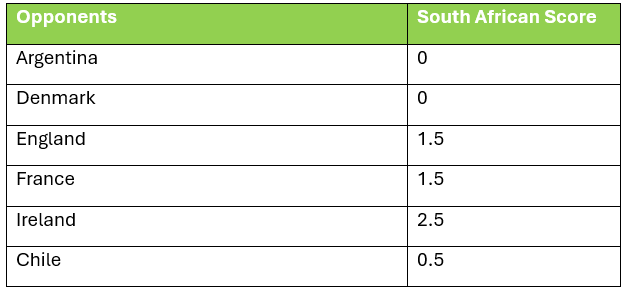
In the Finals held thereafter South Africa finished top of the Section D group. South Africa scored an impressive 28 points out of 36 which is a fantastic score. South Africa scored the following (out of 4).
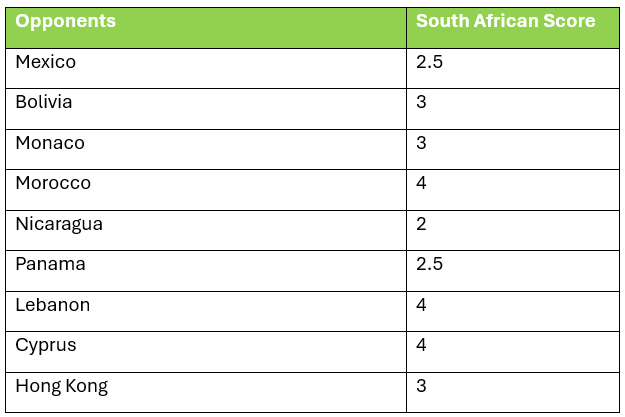
A cursory analysis of the results reveals the following interesting facts:
The late Eddie Price who was well known to modern players as an arbiter scored 72.2 percent at the Olympiad. Nine games played and six wins to boot.
The high number of wins (7) by the late Piet Kroon is also remarkable given that he played board two for the team. Kroon played his last league matches for Bellville in 1996 and competed in the SA Open in 2015.
Pieter Hangelbroek who played in this Olympiad still competed in the 2011 SA Closed B section. What a remarkable achievement.
An interesting aside for me is the fact that when South Africa was readmitted in 1992, we also competed against Argentina in round one, and played against Morocco, Hong Kong, and Ireland.
Cuba and Africa also have a remarkably interesting history. In the book Fidel Castro My Life with Ignacio Ramones (Penguin Books 2008, pages 308-334) Castro recalls with fondness the support Cuba gave to the people of Africa. I quote, “In 1961 a Cuban ship took weapons to the Algerian patriots who were fighting France. And on its return to Cuba, it brought back about 100 children who’d been orphaned and wounded in the war. This story of rescued children would be repeated many years later, in 1978, when the survivors of the Kassinga massacre arrived, the vast majority of whom were children.” Castro goes on to recount with fondness the various countries Che Guevara and other Cuban revolutionaries travelled to in Africa to assist in the various liberation struggles.
The massacre at Kassinga took place on 4 May 1978 when the South African Defence forces bombed a Namibian refugee camp in the Southern Angolan province of Cunene, killing over six hundred people mostly women, children, and old people. My alma mater, the University of the Western Cape, in remembrance of this, named its first female hostel Kassinga.
In modern times (after the events in Angola when South African and Cuban forces clashed) South Africa and Cuba have concluded several agreements. South African students can now go to Cuba for medical training and sport studies whilst Cuba has sent engineers and doctors to South Africa to assist in the rural areas of South Africa.
It was incredibly significant that South Africa competed in Cuba. The politics of the two countries were vastly different. And the fact that South Africa and Cuba actively fought later is an interesting historical footnote. The battle of Cuito Cuanavale is often seen as a turning point in the history of Southern Africa.
The participation in Cuba by a South African team (and indeed an American team led by Bobby Fischer) shows the value sport has in bringing people together. The chess world under the banner of Gens Una Sumus indeed gathered on the soil of Cuba and celebrated Olympism.
The Chess Olympiad book of the 1972 Skopje Olympiad written by Aleksandar Matanovic (Belgrade 1972) notes on page 4 that the Chess Olympiad although a mere expression of the existing chess situation over the course of time came to play a new and key role. They began to exert powerful impulse towards the development of chess in every land affiliated to FIDE. Once a country takes part in an Olympiad, it begins to wish for greater success, so encourages the popularization of the game within its borders and starts to foster the abilities of its players. These days’ Chess Olympiads provide not only the proof of the great popularity for young chess players by the hundreds to cement their attachment to the game, improve their skill, and advance the general level of the game.
Matanovic goes on to note that the ever-increasing influence of Olympiads on chess life in all parts of the world is evidenced by the increasing number of participating countries. The first Olympiad in London (his words) in 1927 attracted teams from 16 countries. The number increased steadily, with slight fluctuations only up to the beginning of the Second World War. At the Buenos Aires Olympiad in August 1939, the then world record of 26 countries took part.
In Leipzig (1960) there were 40; in Tel Aviv (1964) there were 50 and in Siegen (1970) 60. For the first time in history in Skopje an Olympiad for women was also held alongside the Open. This was the fifth Olympiad for women but the first time it is done together.
3. History of Albania ( I thank Google for the information below)
Mesolithic habitation in Albania has been evidenced in several open air sites which were close to the Adriatic coastline and in caves. Mesolithic objects found in a cave near Xarrë include flint and jasper objects along with fossilised animal bones, while those discoveries at Mount Dajt comprise bone and stone tools similar to those of the Aurignacian culture.The Neolithic era in Albania began around 7000 BC and is evidenced in finds which indicate domestication of sheep and goats and small-scale agriculture. A part of the Neolithic population may have been the same as the Mesolithic population of the southern Balkans like in the Konispol cave where the Mesolithic stratum co-exists with Pre-Pottery Neolithic finds. Cardium pottery culture appears in coastal Albania and across the Adriatic after 6500 BC, while the settlements of the interior took part in the processes which formed the Starčevo culture. The Albanian bitumen mines of Selenicë provide early evidence of bitumen exploitation in Europe, dating to Late Neolithic Albania (from 5000 BC), when local communities used it as pigment for ceramic decoration, waterproofing, and adhesive for reparing broken vessels. The bitumen of Selenicë circulated towards eastern Albania from the early 5th millennium BC. First evidence of its overseas trade export comes from Neolithic and Bronze Age southern Italy. The high-quality bitumen of Selenicë has been exploited throughout all the historical ages since the Late Neolithic era until today.
The Indo-Europeanisation of Albania in the context of the IE-isation of the western Balkans began after 2800 BC. The presence of the Early Bronze Age tumuli in the vicinity of later Apollonia dates to 2679±174 BC (2852–2505 BC). These burial mounds belong to the southern expression of the Adriatic-Ljubljana culture (related to later Cetina culture) which moved southwards along the Adriatic from the northern Balkans. The same community built similar mounds in Montenegro (Rakića Kuće) and northern Albania (Shtoj). The first archaeogenetic find related to the IE-isation of Albania involves a man with predominantly Yamnaya ancestry buried in a tumulus of northeastern Albania which dates to 2663–2472 calBC. During the Middle Bronze Age, Cetina culture sites and finds appear in Albania. Cetina culture moved southwards across the Adriatic from the Cetina valley of Dalmatia. In Albania, Cetina finds are concentrated around southern Lake Shkodër and appear typically in tumulus cemeteries like in Shkrel and Shtoj and hillforts like Gajtan (Shkodër) as well as cave sites like Blaz, Nezir and Keputa (central Albania) and lake basin sites like Sovjan (southeastern Albania).
4. Famous people from Albania ( Thanks to Lonely Planet, 2026)
In 1922 after Albania joined the League of Nations, Ahmed Muhtar Zogolli was elected Prime Minister at just 27 years of age. A few years later, Zogolli became president and with Mussolini’s backing, declared himself King Zog in 1928. A day after his wedding in 1939 he fled from Albania after Italy took over Albania.
5. Interesting Fun facts
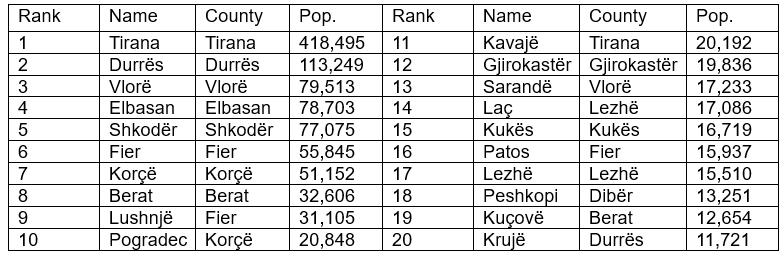
Largest cities and towns in Albania
According to the 2011 census conducted by Instituti i Statistikave (INSTAT)[d]
6. Profile of the players
Dr Shabier Bhawoodien sent me this note compiled by himself.
Dear Chess Family
I hereby give a Short Profile on my Chess Career – Dr Shabier Husain Bhawoodien (Mhatey) Federation Master – FM.
I was introduced to chess in 1972 Fischer – Spassky World Chess Championships by my brothers.
We were listening to the match over the radio, and I was already playing and understanding the moves at 8 to 9 yrs of age.
I read chess books from my brothers and going to our segregated libraries which did not have many chess books.
Our school Trafalgar Junior Primary did not have a library unlike the privileged schools in the Apartheid Era.
I was trying to find books and magazines and concentrated a lot of time on the great Bobby Fischer and other Soviet GMS et al.
I had no coach and most of my chess training was by myself , reading books of Ludek Pachman, Reuben Fine and of Russian chess players Botvinnik, Spassky, Tal, Karpov et al.
I read and studied lots of chess books which I could borrow and lay my hands on.
During my Harold Cressy High School Days I played on Board 1 and maybe , I was unbeaten AS I AM INFORMED, unsure . Never played for Draws.
I participated in many tournaments and played many simultaneous exhibitions and was an active Chess player for Athlone Chess Club which was headed by the late Mr Andre Van Reenen. The motto for SACOS ( South African Council on Sport – NONRACIALISM ) No Normal Sport in an Abnormal Society.
This was A major Sacrifice on our part as we were restricted in terms of our participation across the board.
I met Mr JOHN HESS IN 1980 WHOM WAS MY MENTOR , LIFE AND CHESS COACH FOR MANY YEARS , ALWAYS GRATEFUL FOR HIM , RIP MY GREAT FRIEND.
I have won many Provincial/ Regional Titles some in succession two or more times, South African Champion, Namibian Titles, and represented SA at the All African Games during my continuing illustrious chess career.
Saddest Moment being Politically / Racial Profiling exclusion from 1st Olympiad Team, Praying and Hopefully this will still be corrected .
My son Mohamed Ozayr Bhawoodien is also FM .
HIGHLIGHTS APART FROM SEVERAL TITLES
Played and beating GM Miguel Najdorf in blitz tourney Buenos Aires – Marshall Attack 1996
Winning against GM Nigel Short (Simul Exh 2002)
World Amateur Champion 2003 Johannesburg South Africa
World Senior Team in Dresden and Poland.
I AM STILL AN ACTIVE CHESS PLAYER AND HAVE MANY CHESS FRIENDS INTERNATIONALLY .
IN CONCLUSION
My Dream is to represent South Africa in THE Olympiad Team to correct the discrimination and injustices of the past I HAD FIRST HAND EXPERIENCE OF.
GENS UNA SUMUS – WE ARE 1 BIG CHESS FAMILY
Dr SH Bhawoodien
7. Games from the previous round
Bouah,L (2071) – Barron IM,M (2029) [A83]
World Senior Team (3), 21.04.2026
1.d4 f5 2.e4 the Staunton Gambit is essayed. fxe4 3.Nc3 Nf6 4.Bg5 g6 5.Bxf6 exf6 6.Nxe4 d5 7.Nd2 Bd6 8.Qf3 c6 9.0–0–0 0–0 10.Bd3 Kg7 11.Ne2 Na6 12.c3 Nc7 13.h4 h5 14.Bc2 Bg4 15.Qd3 Bf5 16.Qf3 Bxc2 17.Kxc2 Qd7 18.Rdg1 f5 19.g3 Ne8 20.Qd3 Nf6 21.f3 Rae8 22.Nb3 Rf7 23.Nbc1 Bf8 24.Nf4 Rfe7 25.Qd1 Kf7 26.Ncd3 Qd6 Barron is an experienced IM. He has been playing for a long time. I win the exchange now but I cannot seem to find the knockout blow.
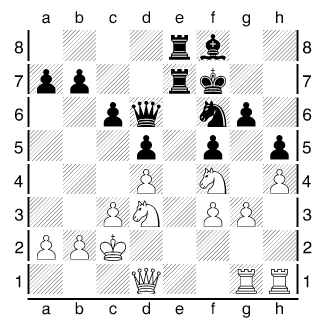
27.Ne5+ Rxe5 28.dxe5 Rxe5 29.Re1 Nd7 30.Nd3 Rxe1 31.Qxe1 c5 32.f4 Bg7 33.Qe2 c4 34.Nf2 Nc5 35.Rd1 Qc6 36.Kb1 b5 37.Qe3 a5 38.Re1 Bf6 39.Nh3 d4 40.cxd4 Nd3 41.d5 Qxd5 42.Qa7+ Kf8 43.Qb8+ Kg7 44.Qa7+ Kf8 45.Qb8+ Kg7 ½–½ A difficult position at the end as he is threatening Qg2 and Qh1 if my rook should move. We decided on a draw.
Oancea,N (1877) – Bhawoodien,S (2026)
World Senior Team (3), 21.04.2026
e4 e5 2.Nf3 Nc6 3.Bb5 a6 4.Ba4 Nf6 5.d3 d6 6.c3 b5 7.Bc2 Be7 8.h3 0–0 9.0–0 h6 10.Re1 Re8 11.Nbd2 Bf8 12.Nf1 g6 13.Ng3 Bg7 14.Bd2 Rb8 15.Qe2 a5 16.d4 Nd7 17.d5 Ne7 18.b4 axb4 19.cxb4 c6 20.dxc6 Nxc6 21.Bd3 Qb6 22.Be3 Nd4 23.Qd2 h5 24.Ne2 Nxf3+ 25.gxf3 Qb7 26.Nc3 Nf8 27.Bxb5 A difficult Ruy Lopez was essayed. Shabier now decides to go for it!

Bxh3 28.Bxe8 Rxe8 29.b5 Ne6 30.a4 Qe7 31.Ne2 f5 32.f4 Qh4 33.f3 a complicated position. There are four black pieces on the white kingside and while white is winning the endgame with his two passed pawns, the question is will he survive the attack.
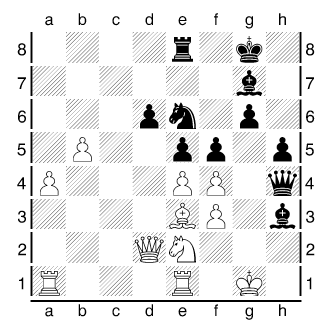
fxe4 34.Bf2 Qe7 35.fxe4 exf4 36.Nxf4 Qg5+ 37.Bg3 Qxg3+ 38.Ng2 Bd4+ 39.Kh1 Bg4 40.Ne3 Bf3+ 41.Qg2 Qh3+
Schutte, Andre – Keller, Christopher (1993) [A10], World Senior Team (2), 20.04.2026
1.c4 b6 2.Nc3 e6 3.Nf3 Bb7 4.e3 f5 5.b3 Nf6 6.Be2 Be7 7.Bb2 0–0 8.0–0 Ne4 9.d3 Ba3
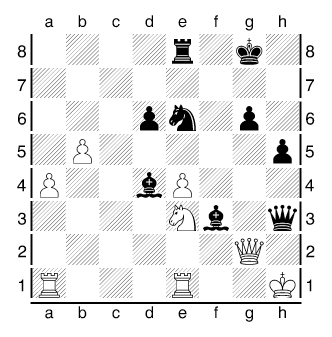
42.Kg1 Bxe3+ and resign 0–1
7. Results of Round three

In the fourth round, South Africa faced a challenging match and ultimately lost to the USA women’s team. On board one, the WGM defeated CM Lyndon Bouah in a well-played game; during their post-game analysis, which lasted an hour, she pointed out where he had missed a tempo and shared insights from her time at the prestigious Botvinnik school of chess. Meanwhile, the rest of the team saw mixed results: Dr. Shabier Bhawoodien fought to a draw on board two, Anton Goosen suffered a loss on board three, and Andre Schutte secured a victory for the team on board four.