

1. Introduction
The matches are of course all tough. There are no easy matches. Many of the players have retired or are close to retirement and have decided to come play in this event. Many of them have of course lost a bit of strength but they have not lost their understanding of the game!
Today is World Book Day- 23 April. In honour of today, i have decided to purchase two books. The books are about the life and games of GM Dragoljub Velimirovic. He was on the most exciting grandmasters. I shall enjoy the two part series on his life.
I have also written now 14 books. The latest book will be released next month. It is about the Olympiad in India 2022. In June 1992 I played my first international chess event which was the Chess Olympiad in Manila, Philippines. Since then, I have had a soft spot for this fantastic competition which brings together chess players from all countries in the world. I have decided that it is important to record the South African history at these Chess Olympiads. In this book I have analysed all the games from the South Africa’s Open and Women’s team played in Chennai, India in July/ August 2022 and have drawn important lessons from all the games played over the eleven rounds played at the event. Vishy Anand is the hometown of former world champion Vishy Anand.
2. South Africa at the Olympiads
The next Olympiad was held in 1968 in Lugano, Switzerland. Arpad Foldeak (Chess Olympiads, Dover publications, 1968) notes on page 383 of his book that the event in Lugano was the first one to be held on European soil in the last six years since 1962. Countries such as Andorra, Costa Rica, Singapore and the United States Virgin Islands were making their appearance for the first time in an Olympiad.
A new arrangement was also introduced, whereby teams that qualified for the same final section did not have to play again against the same opponents. The results of those matches would simply be carried over to the Finals.
There were seven preliminary groups with South Africa drawn in group three. The teams South Africa faced were Yugoslavia, Poland, Spain, Scotland, Luxembourg and Dominica.

South Africa (0) lost to Yugoslavia, scored a half against Poland, (0) against Spain, drew with Scotland 2-2, beat Luxembourg 2.5 and beat Dominica handsomely by 3.5 with all matches out of four.
In the Finals, South Africa played some great chess and was able to take points off strong teams and beat some notable countries as well as earn 27.5 edging out Tunisia on 26 and Morocco with 16. It is interesting to note that South Africa beat Venezuela, Portugal, Tunisia, Puerto Rico and Monaco. Credible draws were played against Turkey and Ireland. The six players, who competed for South Africa, all fared well, with the standout being Heyns who scored 61.5 %. It is interesting that Friedgood played 15 games at the Olympiad and several grandmasters played up to seventeen games at the Olympiad!
18th Chess Olympiad: Lugano, Switzerland 1968

South Africa at this time was reeling after the fiasco of the Basil D’Oliviera matter. D’Oliviera was a cricket player from Cape Town who because of apartheid had left South Africa to pursue his potential. Because of his cricket prowess he was picked for the England team that would tour South Africa. The tour was however called off because England felt that their team would not be welcome and that they didn’t want any interference in the selection of their team.
South Africa competed in Siegen in 1970. The team was the following:
19th Chess Olympiad: Siegen, Germany 1970

The match against Albania was not considered. (Source: SA Chessplayer October1970). This was highly significant. Albania had taken a principled stance against apartheid and their government informed the team that they were not under any circumstances to play against South Africa. This was a very courageous decision by the Albanian team as they forfeited the points.
South Africa did not receive an invitation to Skopje in Yugoslavia. The Communist Bloc was of course fiercely opposed to Apartheid and had broken all ties with South Africa. So, South Africa would not have been able to obtain visas to Yugoslavia in 1972 let alone an invitation. South Africa had also been banned since 1963 from participating in the Olympic Games.
3. History of Albania
Albania in the Middle Ages
The town of Krujë was the capital of the Principality of Arbanon in the Middle Ages.
The Roman Empire was split in 395 upon the death of Theodosius I into an Eastern and Western Roman Empire in part because of the increasing pressure from threats during the Barbarian Invasions. From the 6th century into the 7th century, the Slavs crossed the Danube and largely absorbed the indigenous Greeks, Illyrians and Thracians in the Balkans; thus, the Illyrians were mentioned for the last time in historical records in the 7th century.
In the 11th century, the Great Schism formalised the break of communion between the Eastern Orthodox and Western Catholic Church that is reflected in Albania through the emergence of a Catholic north and Orthodox south. The Albanian people inhabited the west of Lake Ochrida and the upper valley of River Shkumbin and established the Principality of Arbanon in 1190 under the leadership of Progon of Kruja. The realm was succeeded by his sons Gjin and Dhimitër.
Upon the death of Dhimiter, the territory came under the rule of the Albanian-Greek Gregory Kamonas and subsequently under the Golem of Kruja. In the 13th century, the principality was dissolved. Arbanon is considered to be the first sketch of an Albanian state, that retained a semi-autonomous status as the western extremity of the Byzantine Empire, under the Byzantine Doukai of Epirus or Laskarids of Nicaea.
A relief of the Scuola degli Albanesi commemorating the siege of Shkodra. It illustrates Sultan Mehmet II laying siege to the Albanian town of Scutari, then part of Venetian Empire.
Towards the end of the 12th and beginning of the 13th centuries, Serbs and Venetians started to take possession over the territory. The ethnogenesis of the Albanians is uncertain; however, the first undisputed mention of Albanians dates back in historical records from 1079 or 1080 in a work by Michael Attaliates, who referred to the Albanoi as having taken part in a revolt against Constantinople. At this point the Albanians were fully Christianised.
After the dissolution of Arbanon, Charles of Anjou concluded an agreement with the Albanian rulers, promising to protect them and their ancient liberties. In 1272, he established the Kingdom of Albania and conquered regions back from the Despotate of Epirus. The kingdom claimed all of central Albania territory from Dyrrhachium along the Adriatic Sea coast down to Butrint. A Catholic political structure was a basis for the papal plans of spreading Catholicism in the Balkan Peninsula. This plan found also the support of Helen of Anjou. Around 30 Catholic churches and monasteries were built during her rule mainly in northern Albania.[52] Internal power struggles within the Byzantine Empire in the 14th century enabled Serbs’ most powerful medieval ruler, Stefan Dusan, to establish a short-lived empire that included all of Albania except Durrës.
Albanian principalities, c. 1390, excluding the Despotate of Arta
In 1367, Albanian rulers established the Despotate of Arta. During that time, several Albanian principalities were created, notably the Principality of Albania, Principality of Kastrioti, Lordship of Berat and Principality of Dukagjini. In the first half of the 15th century, the Ottoman Empire invaded most of Albania, and the League of Lezhë was held under Skanderbeg as a ruler, who became the national hero of the Albanian medieval history.
4.Famous people from Albania
One of the most iconic figures in Albanian history is Queen Teuta (231- 228 BC). She was known as the pirate queen of Illyria After her husband’s King Argons’ untimely death, and with his heir too young, Teuta took charge of the kingdom. Ticked off that their ships were getting robbed. Rome sent envoys to Queen Teuta. It is rumoured she killed one envoy and seized the ship of the other thus setting off a war with Rome.
5. Interesting Facts about Albania
Butrint has been included in the UNESCO list of World Heritage Sites since 1992.
The artistic history of Albania has been particularly influenced by a multitude of ancient and medieval people, traditions and religions. It covers a broad spectrum with mediums and disciplines that include painting, pottery, sculpture, ceramics and architecture all of them exemplifying a great variety in style and shape, in different regions and period.
The rise of the Byzantine and Ottoman Empire in the Middle Ages was accompanied by a corresponding growth in Christian and Islamic art in the lands of Albania which are apparent in examples of architecture and mosaics throughout the country.[379] Centuries later, the Albanian Renaissance proved crucial to the emancipation of the modern Albanian culture and saw unprecedented developments in all fields of literature and art whereas artists sought to return to the ideals of Impressionism and Romanticism. However, Onufri, Kolë Idromeno, David Selenica, Kostandin Shpataraku and the Zografi Brothers are the most eminent representatives of Albanian art.
The architecture of Albania reflects the legacy of various civilisations tracing back to the classical antiquity. Major cities in Albania have evolved from within the castle to include dwellings, religious and commercial structures, with constant redesigning of town squares and evolution of building techniques. Nowadays, the cities and towns reflect a whole spectrum of various architectural styles. In the 20th century, many historical as well as sacred buildings bearing the ancient influence were demolished during the communist era.
Ancient architecture is found throughout Albania and most visible in Byllis, Amantia, Phoenice, Apollonia, Butrint, Antigonia, Shkodër and Durrës. Considering the long period of rule of the Byzantine Empire, they introduced castles, citadels, churches and monasteries with spectacular wealth of visible murals and frescos. Perhaps the best known examples can be found in the southern Albanian cities and surroundings of Korçë, Berat, Voskopojë and Gjirokastër. Involving the introduction of Ottoman architecture there was a development of mosques and other Islamic buildings, particularly seen in Berat and Gjirokastër.
6. Profile of the players - Lyndon Bouah
In June 1992 I played my first international chess event which was the Chess Olympiad in Manila, Philippines. Since then, I have had a soft spot for this fantastic competition which brings together chess players from all countries in the world.
I hold the title of Candidate Master in chess. I qualified for this title at the 1992 Chess Olympiad. I also competed for South Africa at various international events including the 1993 African Junior Championship in Nairobi where I was the joint runner-up, the 1994 Moscow Olympiad in Russia and thereafter the African Team and Individual Championships in Nigeria in 2003 and various African Individual Championships in Zambia in 2005, Uganda in 2016 and the Zonals in Zambia in 2017.
In July 2024, I played on Board One for South Africa at the World Senior Team Championships in Poland after I jointly clinched the title of SA Over-50 Championship in April 2024. In Poland I scored 6/9 on board one for South Africa. I played Board one for SA at the World Senior Team Championship held in Durres, Albania in April 2026.
I have been the captain of the SA Chess team at the 2002, 2004, 2014, 2016 and 2018 Chess Olympiads held in Slovenia, Spain, Norway, Azerbaijan, and Georgia. I was also captain of the team that won the Zone 4.3 team championships in Mozambique in 2008. I was also the captain of the SA team at the World Senior Team Championship in Krakow, Poland in July 2024.
I led WP to ten interprovincial team Championships and has been the Steinitz Chess Club Captain that has seen them win eight national club titles, eight provincial club titles and 12 WP league titles. In my own right, I have won multiple SASSSA Championships in team and individual championships as well WP Open and WP Closed Championships, the EP Closed Championship, University championships, and various other open events across the country.
I have served chess as an administrator, coach, player, and journalist for the last 40 years. I am an Advocate of the High Court of South Africa and completed my law degrees at UWC and UCT and PHD at UWC in 2016. In October 2025 I was awarded a Lifetime Achiever Award by the Cape Town Metro Sport Council for my contributions over the last 40 years to chess.


Schutte, Andre (1810) – Jezierska, Ivona (2027) [A16]
World Senior Team (4), 22.04.2026
1.c4 Nf6 2.Nc3 d6 3.e3 g6 4.d4 Nbd7 5.Nf3 Bg7 6.Rb1 e5 7.b4 0–0 8.Be2 e4 9.Nd2 Re8 10.Qb3 c6 11.c5 d5 12.b5 Nf8 13.Qa4 Bd7 14.Nb3 a6 15.bxa6 bxa6 16.Na5 Re6 17.Nb7 Qe7 18.Rb6 Ra7 19.Ba3 Ne8 20.0–0 f5 21.Rfb1 f4 22.Rxa6 Rxa6 23.Qxa6 fxe3 24.fxe3 Qg5 25.Nd1 Rf6 26.Bc1 Nc7 27.Qa5 Bh3 28.g3 Qf5 29.Qe1 Qg5 30.Nf2 Bd7 31.a4 h5 32.Nd6 h4
Andre now decided to play an interesting move. Dear reader, can you spot the interesting move?
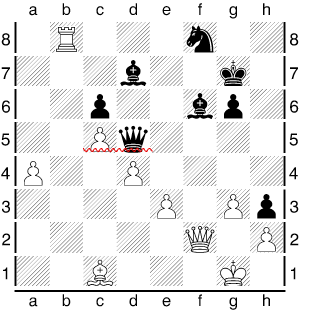
33.Nfxe4! dxe4 34.Nxe4 Qf5 Mr Schutte has sacrificed his two knights for a rook and two central pawns. By this, he creates an imbalance which will probably together with his passed a-pawn be sufficient to win the game!

35.Nxf6+ Bxf6 36.Rb7 Nd5 37.Bc4 Qe4 38.Qf2 h3 39.Rb8 Kg7 40.Bxd5 Qxd5 Andre who now was winning finds the cleanest way to win. Winning a won game is sometimes the most difficult thing as many readers will know from personal experience. What did the intrepid Bellville Chess Club stalwart find here?
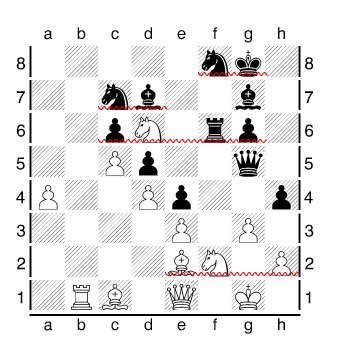
41.Rxf8! white will now obtain two pieces for the rook and have an armada of pawns! Bf5? 42.Rxf6 a second piece is captured Kxf6 43.g4! and now the bishop is pinned because the rook has forced black to lose a third piece. You can’t ask more from a tank! Qe4 44.gxf5 Qg4+ 45.Qg3 Qd1+ 46.Kf2 Qc2+ 47.Kf3 Qd1+ 48.Kf4 Qf1+ 49.Qf3 g5+ 50.Kg3 Qxc1 51.Qxc6+ Kf7 52.Qe6+ Kf8 53.Kxh3 Qf1+ 54.Kg4 Qg2+ 55.Kh5 Qxh2+ 56.Kg6 1–0
7. Results of Round three

In conclusion, our fifth-round encounter against Wales proved to be a breakthrough moment for the team as we secured a convincing 3.5 – 0.5 victory. On board one, I managed a draw against FM Sven Zeitler, though I likely had a winning position; as I’ve noted before, converting a won game remains one of the most difficult challenges in chess. Board two saw FM Shabir display immense tenacity to eventually break down his opponent for a full point, while CM Anton Goosen produced a clinical performance on board three to outplay his rival. Finally, on board four, Andre Schutte showed his mettle by securing his second consecutive win, utilising the same fighting spirit he demonstrated in his previous tactical masterclass. We are delighted to have notched our first match win of the tournament and look forward to carrying this momentum into the coming rounds.